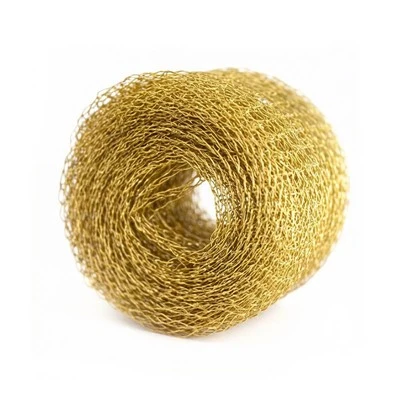

The thermal expansion coefficient is a crucial physical property that describes how a material changes in volume or length in response to temperature variations. When it comes to Mist Eliminator Mesh, understanding its thermal expansion coefficient is essential for ensuring its proper functioning in various applications. As a leading supplier of Mist Eliminator Mesh, we are well - versed in the technical details of this product, including its thermal expansion characteristics.
What is the Thermal Expansion Coefficient?
The thermal expansion coefficient (α) is defined as the fractional change in a material's dimension (length, area, or volume) per degree change in temperature. For linear expansion, the formula is $\Delta L = L_0\alpha\Delta T$, where $\Delta L$ is the change in length, $L_0$ is the original length, $\alpha$ is the linear thermal expansion coefficient, and $\Delta T$ is the change in temperature.
For Mist Eliminator Mesh, the thermal expansion coefficient can significantly impact its performance. In applications where the mesh is exposed to high - temperature environments, such as in chemical processing plants or power generation facilities, the expansion and contraction of the mesh due to temperature changes can affect its structural integrity and separation efficiency.
Factors Affecting the Thermal Expansion Coefficient of Mist Eliminator Mesh
The thermal expansion coefficient of Mist Eliminator Mesh depends on several factors, including the material used to manufacture the mesh. Common materials for Mist Eliminator Mesh include stainless steel, polypropylene, and fiberglass, each with its unique thermal expansion properties.

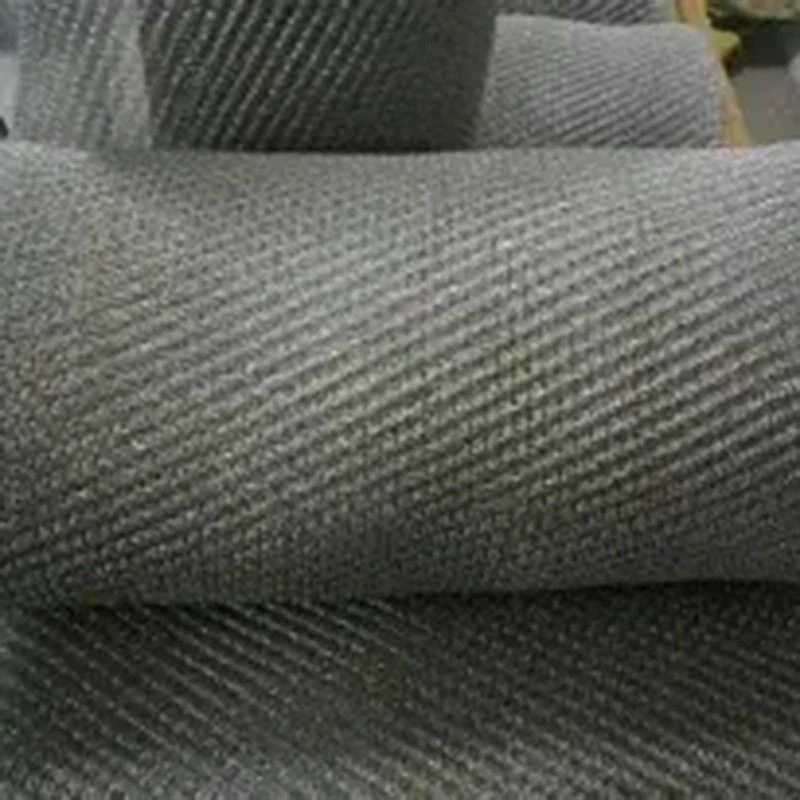
- Stainless Steel: Stainless steel Mist Eliminator Mesh is widely used due to its high strength, corrosion resistance, and durability. The linear thermal expansion coefficient of stainless steel typically ranges from approximately $10\times10^{-6}/^{\circ}C$ to $17\times10^{-6}/^{\circ}C$, depending on the specific grade of stainless steel. This relatively low thermal expansion coefficient makes stainless steel mesh a good choice for applications where temperature stability is required. For example, in a distillation column, the stainless steel Mist Eliminator Mesh can maintain its shape and performance even when exposed to high - temperature vapors.
- Polypropylene: Polypropylene is a lightweight and cost - effective material for Mist Eliminator Mesh. However, it has a relatively high thermal expansion coefficient, usually around $100\times10^{-6}/^{\circ}C$ to $200\times10^{-6}/^{\circ}C$. This means that polypropylene mesh can expand and contract significantly with temperature changes. In applications where the temperature is relatively stable, polypropylene mesh can be a suitable option. But in high - temperature or temperature - cycling environments, special design considerations may be needed to account for its large thermal expansion.
- Fiberglass: Fiberglass Mist Eliminator Mesh offers excellent chemical resistance and mechanical strength. Its thermal expansion coefficient is relatively low, typically in the range of $5\times10^{-6}/^{\circ}C$ to $9\times10^{-6}/^{\circ}C$. Fiberglass mesh is a good choice for applications with high - temperature requirements and where dimensional stability is crucial.
Implications of Thermal Expansion for Mist Eliminator Mesh Applications
The thermal expansion of Mist Eliminator Mesh can have several implications for its applications:
- Installation and Structural Integrity: During installation, the thermal expansion coefficient needs to be considered to ensure that the mesh has enough room to expand and contract without causing damage to the supporting structure. For example, if a stainless steel Mist Eliminator Mesh is installed in a fixed - frame structure without proper allowance for expansion, it may bend or warp at high temperatures, leading to a decrease in separation efficiency.
- Separation Efficiency: Thermal expansion can also affect the separation efficiency of the Mist Eliminator Mesh. When the mesh expands or contracts, the pore size and structure of the mesh may change, which can impact the ability of the mesh to capture and remove mist droplets from the gas stream. In extreme cases, large - scale expansion or contraction can cause the mesh to become loose or detached from its support, resulting in a complete loss of separation performance.
- Long - Term Performance: Over time, repeated thermal cycling can cause fatigue in the Mist Eliminator Mesh. Materials with high thermal expansion coefficients are more prone to fatigue, which can lead to cracks and breakage in the mesh. This can reduce the lifespan of the mesh and increase maintenance costs.
Our Role as a Mist Eliminator Mesh Supplier
As a trusted [Supplier's role] of Mist Eliminator Mesh, we understand the importance of the thermal expansion coefficient in the performance of our products. We offer a wide range of Mist Eliminator Mesh materials, including stainless steel, polypropylene, and fiberglass, to meet the diverse needs of our customers.
When you choose our Mist Eliminator Mesh, you can expect:
- Expert Advice: Our team of technical experts can help you select the most suitable material based on your specific application requirements, including temperature range, chemical environment, and separation efficiency needs. We can analyze your operating conditions and recommend the optimal Mist Eliminator Mesh with the appropriate thermal expansion characteristics.
- High - Quality Products: We source our materials from reliable suppliers and use advanced manufacturing processes to ensure the highest quality of our Mist Eliminator Mesh. Our products are rigorously tested to meet the industry standards and specifications, including resistance to thermal expansion and contraction.
- Customized Solutions: We understand that every application is unique. That's why we offer customized Mist Eliminator Mesh solutions. Whether you need a specific size, shape, or material, we can work with you to design and manufacture a product that meets your exact requirements.
We also provide related products such as Demister Mesh, Metal Mesh Filter Screen, and Metal Mesh Mist Eliminator, all of which are carefully engineered to perform well under different working conditions.
Contact Us for Procurement
If you are in the market for high - quality Mist Eliminator Mesh, look no further. We are committed to providing you with the best products and services. Whether you have a small - scale project or a large - scale industrial application, we have the expertise and resources to meet your needs.
Contact us today to discuss your requirements and start a procurement negotiation. Our team of sales representatives is ready to assist you and provide you with a detailed quote. Visit our website Mist Eliminator Mesh to learn more about our products and services.
References
- Callister, W. D., & Rethwisch, D. G. (2010). Materials Science and Engineering: An Introduction. Wiley.
- ASM Handbook Committee. (2000). ASM Handbook, Volume 2: Properties and Selection: Nonferrous Alloys and Special - Purpose Materials. ASM International.